The player from Quebec had repeatedly created new accounts at Rollbit while under an active self-exclusion, despite passing KYC verification on each attempt. He had incurred over $120,000 in losses during this period and sought a refund of those losses, permanent account closure, and preservation of all related records. The complaint remained unresolved as the casino had not cooperated with the mediation process, consistently ignoring communication attempts from the Complaints Team. Due to the lack of response from Rollbit, the complaint was closed, and the casino's overall rating was affected. The player was advised to contact the Curaçao Gaming Authority for further assistance.
Rollbit Casino - Player's accounts were wrongly approved during self-exclusion.
Unresolved
Our verdict
No reaction policy
Black points: 6,007
Amount: 1,500 ◎

Rollbit Casino
Safety Index 4.1 LowCase summary

Discussion
Public



Public
3 months ago
I self-excluded from Rollbit on my main account because I had a gambling problem. While that self-exclusion was still active, I was able to register a new account under the same legal identity. Rollbit ran its KYC identity verification on the new account, matched it against the same ID documents already on file, approved it, and allowed me to deposit and gamble. I lost money and self-excluded again. The same thing then happened a second and a third time: each new account was created during an active self-exclusion period, passed Rollbit's KYC against the same verified identity, was approved by Rollbit, and was allowed to deposit and play leading to over 120,000$+ net loss in 2 weeks.
Rollbit's own Responsible Gaming policy states that a self-excluded player may not create a new account during the exclusion period. Because Rollbit carried out KYC each time and matched every new account to the same verified identity and ID documents already linked to a self-excluded account, its own systems had every opportunity to detect and block the re-registration — and failed to do so on three separate occasions. The purpose of KYC and self-exclusion is to make this technically enforceable; Rollbit verified exactly who I was each time and let me back in regardless.
I raised this with Rollbit directly. Their compliance team acknowledged my email and asked me to submit a formal complaint with supporting details, which I have done. However, they indicated a 20-business-day response window, whereas responsible-gaming complaints under the Curaçao framework are to be handled within 5 business days.
Resolution I am seeking:
- A refund of my net losses (deposits minus withdrawals) on every account created and used while a self-exclusion was active.
- Permanent closure and permanent block of all accounts linked to my identity and KYC documents.
- Preservation of all my KYC records, account logs, deposit and withdrawal history, betting history, chat/email logs, and self-exclusion records.
Public


Public
3 months ago
Important notice:
Casino Guru will never ask for payments or access to your accounts to complete KYC. If someone claims to be from Casino Guru and does that, do not share any information.
We only contact players through this official complaint thread or via @casino.guru e-mail addresses. Always check the sender’s domain and verify your complaint resolver’s e-mail address by clicking on their avatar visible inside the official complaint thread.
If anything seems suspicious, contact us directly.
Stay safe.
Public
Public
3 months ago
Dear satoshi, thank you very much for submitting your complaint. I am truly sorry about your negative experience with Rollbit Casino. Please allow me to ask you a few questions, so I can understand the whole situation completely.
- Could you please confirm whether you currently still have access to your account?
- Could you please confirm whether you have passed the KYC verification on all of your accounts?
- Could you please share your original self-exclusion request? Send emails or chat transcripts to my email at attila.g@casino.guru, or post screenshots here.
I hope we will be able to help you to resolve this issue as soon as possible.
Thank you very much in advance for your reply.
Best regards,
Attila
Public
Public
3 months ago
Hi Atilla,
thank you for the fast answer.
Could you please confirm whether you currently still have access to your account?
- Yes I have access to every single account
Could you please confirm whether you have passed the KYC verification on all of your accounts?
- Yes, all under my legal name and verified with ID. Exact same name and my name is one of a kind there can't be two persons with this name.
Could you please share your original self-exclusion request? Send emails or chat transcripts to my email at attila.g@casino.guru, or post screenshots here.
- Rollbit doesn't send self exclusion email they simply log you out of your account and show you the date you can access your account when trying to log in. We don't receivr confirmation emails. They likely have it on file only.
kind regards
Public
Public
3 months ago
Dear Player,
Unfortunately, we have come to a point where we are not able to move forward with this complaint. Generally, we would now try to get in touch with the casino and ask for their explanation, however, this one has 25+ cases closed as "No Reaction Policy," which clearly shows the casino is not interested in cooperating with us. Sadly, we are forced to close your complaint as "unresolved". This will affect the overall rating of the casino. I understand this isn't a satisfactory solution to your issue; however, the decrease in rating caused by unresolved complaints could change the casino's approach.
Regrettably, it seems to be a common practice of Rollbit Casino to ignore us completely in our attempts to mediate any kind of issue. Please check all our previous failed attempts to negotiate.
We have sent numerous emails and tried to communicate with live chat representatives as well as with affiliate team members. Unfortunately, all efforts to resolve any kind of issue have died as the complaints grew in numbers. We strictly recommend staying away from Rollbit Casino. I wish I could be of more help.
I recommend contacting the Curaçao Gaming Authority (complaints@cga.cw) and submitting a complaint to them. The Gaming Authority might have more options and tools to help players. You can learn more on how to submit a complaint to the regulator here: https://casinoguru-en.com/submitting-complaints-to-regulators
The casino can reopen this complaint anytime.
Best regards
Attila
As part of our Global Self-Exclusion Initiative, we've partnered with BetBlocker, a UK-registered charity providing a free service to support people worldwide. You can find more information about our initiative here (https://casino.guru/global-self-exclusion-initiative) and about BetBlocker here (https://betblocker.org/).
BetBlocker, which supports seven languages, is quick and easy to install on multiple devices, taking just 2 minutes. Once installed, it blocks access to over 84,230 gambling websites and runs quietly in the background. The service can be used anonymously and helps individuals manage their access to gambling safely and appropriately, whether that means complete restriction or limiting access during vulnerable periods.
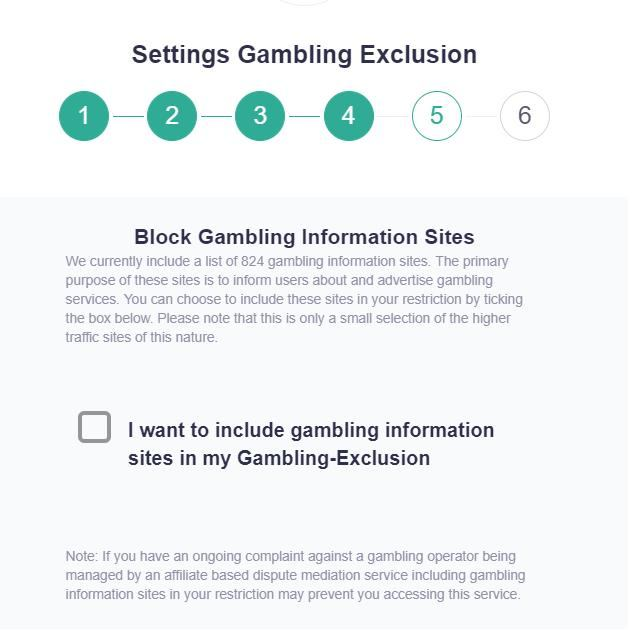
Additionally, BetBlocker includes a list of 824 gambling information sites. These sites primarily inform users about and advertise gambling services. You can choose to include these sites in your restriction by ticking a box. However, if you have an ongoing complaint against a gambling operator, do not check this box, as it will prevent you from accessing the Casino.Guru website as well.