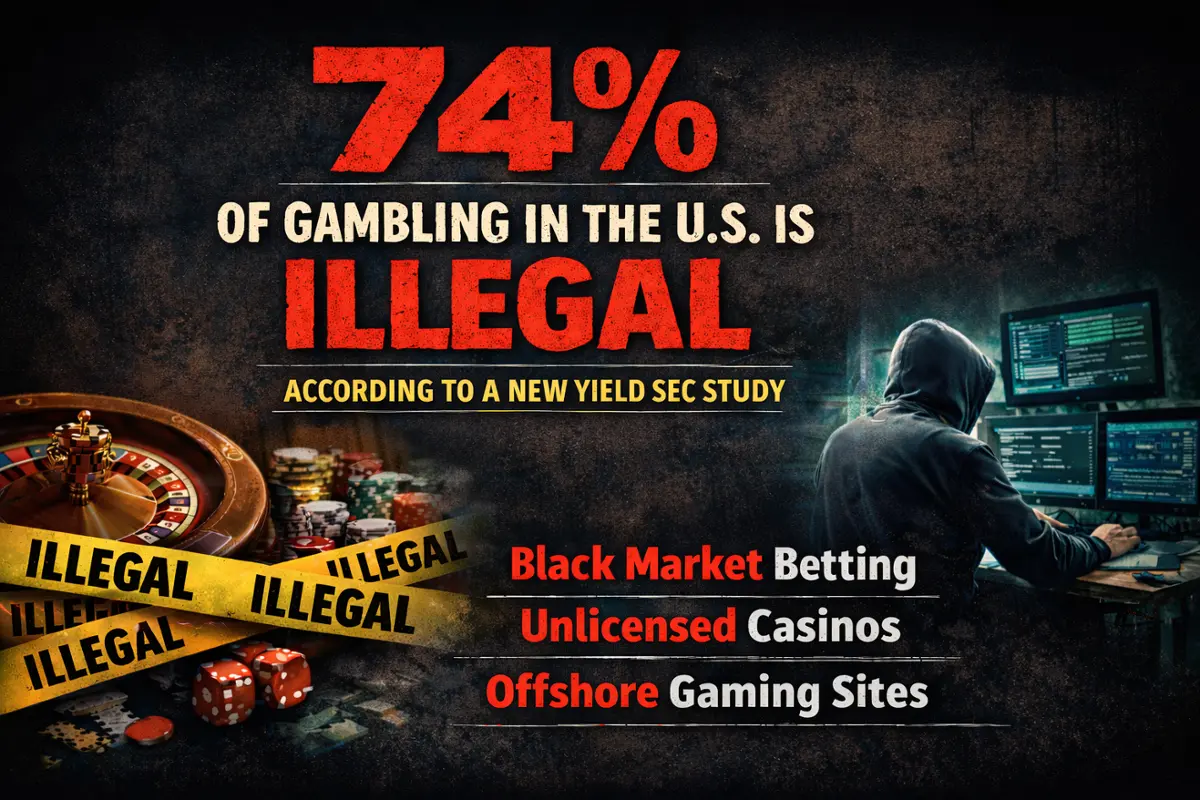
Yield Sec says 74% of US gambling goes to illegal operators

- The bulk of gambling-generated gross revenue online was illegal in the first six months of 2025
- 74% of the revenue is now generated with black market operators and brands, estimates Yield Sec
- The survey argues that there is a fundamental issue with how the illegal market is addressed - legalization is not a panacea
As the United States continues to expand its online gambling industry, a new study by Yield Sec, commissioned by the Campaign for Fairer Gambling, suggests that the industry does not have a growing problem - but a black market platform.
Based on the latest data by Yield Sec, 74% of all gross gambling revenue online is plowed into offshore operators that are not licensed in the United States, leading to significant losses for states and players.
Legalization of gambling in the US is not helping tackle the clout of illegal gambling
The study specifically focuses on the first six months of the year - 2025, concluding that out of the $52bn GGR recorded, $38.7bn was placed with unauthorized websites.
Legal online betting is already fueling a higher incidence of both gambling and consumer losses, the authors noted in the public press release. Matej Novota, Casino Guru's Head of Casino Research, also commented on the findings:
"We can legalize every form of gambling in the US, but unless enforcement catches up to the years of neglect, players will continue to choose offshore sites that already have the trust, familiarity, and convenience that the regulated market never built."
The states with more forms of legal gambling are also driving the highest GGR per capita as a percentage of income, but once again, the issue remains: black market operators are scooping up the bulk of this.
While legalizing various verticals has long been touted as a way to counteract the offshore and black market operators, Yield Sec believes that not much has been done to achieve this in earnest.
"The marketplace simply grows and illegal and unregulated operators become the unintended winners as they exploit their dominant control of cross-sell mechanics, new products like crypto gambling, and their status as the "one-stop gambling shops" for American consumers," the company stated.
CFG Founder and Funder, Derek Webb, commented on the latest results, arguing that the claim that legalization would lead to an automatic reduction of the illegal online sector has fallen short of the mark.
"This is false, and legal representations to this effect are perjury. There is still no evidence of meaningful action against the black market at either the state or federal level. The numbers show that as the total market continues to grow, illegal operators share in that growth," Webb added.
This sentiment was echoed by the President of Gaming Compliance International (the company that owns Yield Sec), Ismail Vali, who also picked up on the legalization versus reducing illegal gambling. Presently, pushing for legalization alone would not yield the desired outcomes, Vali explained, outlining a much more complicated path to success instead.
"Taking back control, at the state and federal levels, and enabling the abilities of legal operators to make the money they should, to benefit American commerce, community and consumers, will only come via one path that must impact policy, process and practice: the path of MPEO – Monitor, Police, Enforce and Optimize. It is the only path which takes America’s online gaming marketplace from chaos to control," he wrapped up.
Yield Sec identifies reasons why this is happening
The report went a step further to outline four core reasons why these unlicensed (statewide) operators continue to dominate.
Such black market operators have a strong cross-selling platform between their sports betting and casino operations, for one. They often offer better products in terms of prices and returns, as they are not burdened by licensing fees or taxation.
Another reason is the porous gambling framework that allows for certain activities in one state, but not in neighboring ones, leading to confusion among players and allowing rogue operators to exploit this.
Not least, because of the above, these websites have consistently strengthened their dominance of the sector as indicated in the latest survey.
Image credit: Unsplash.com

FanDuel and DraftKings face lawsuit in Louisiana over consumer protection concerns

KSA slams €37m fine on alleged illegal gambling operator

L & L Europe Limited reaches £900,000 settlement with UKGC

ACMA publishes wagering ad rules on "notable people"

Tax hike threatens venues, jobs across Britain, BGC warns

CFTC seeks to define and delineate event contracts and gambling

Cambodia steps up efforts to restrict illegal gambling

Michigan goes after 33 illegal and offshore gambling websites

UK Gambling Commission settles with Rank Group-owned operators over land-based RG failures

Meta and Paf team up for key pilot meant to help identify illegal gambling websites

Bulgarians pay the bill: €1bn lost to gambling every year

Polymarket challenges Dutch ban in court
Most popular news


Send us a tip
RECOMMENDED TOPICS
gambling industryresponsible gamblinglotterysports bettingappointmentsgambling lawsjackpots